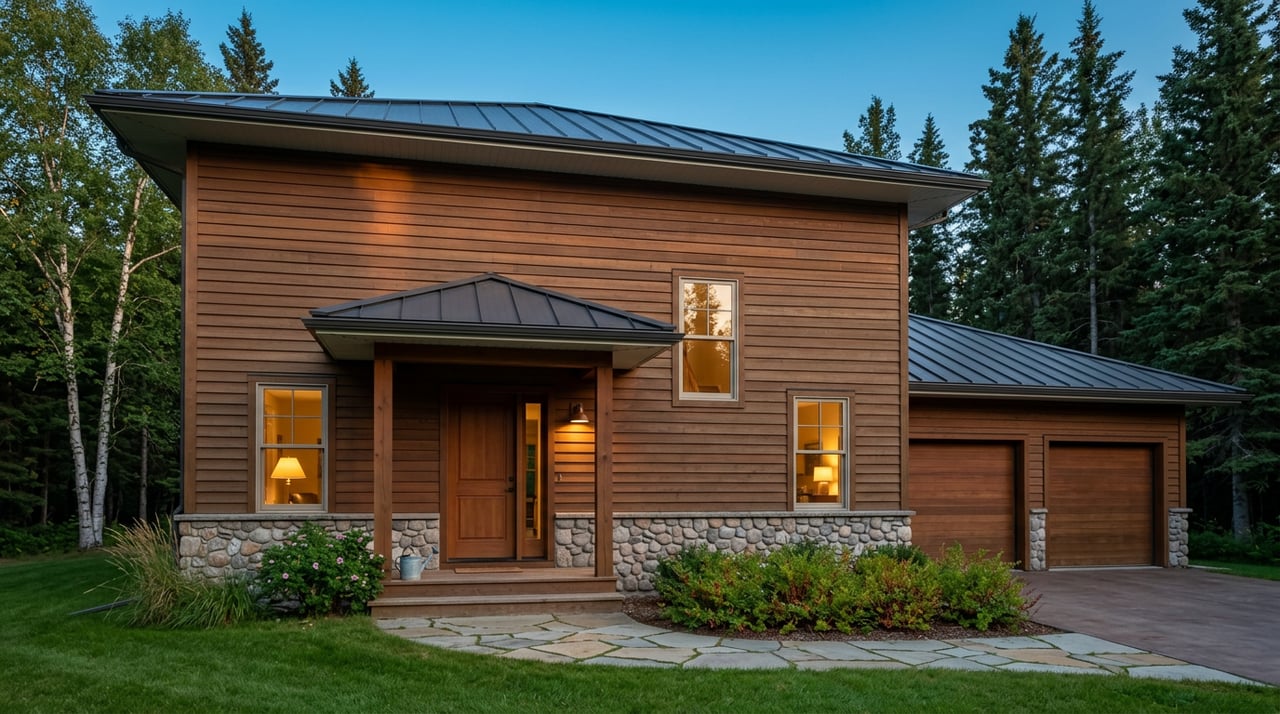
Doyon Estates Fairbanks Riverfront Homes: What Drives Value
July 16, 2026
July 16, 2026
Pull up any portal and Doyon Estates looks like an outlier. The Fairbanks North Star Borough median sale price sat at roughly $342,000 in March 2026, and the City of Fairbanks median hovered near $244,000 the same month. A single active Doyon Estates listing this spring was asking north of two million. The reflex is to assume you are paying for square footage or finish level.
You are not. You are paying for a buildable envelope on a small, HOA-governed tract of Chena River frontage, and the price reflects a specific set of land-use rules, hydrology, and inventory scarcity that most buyers never see until they are inside the transaction. This post walks through what the premium actually represents, so a move-up buyer or relocating family can read a Doyon Estates comp the way a listing agent does.
Borough and city medians are a blended average of ranch homes on standard lots, condos, older cabins, and the occasional acreage sale. In March 2026, Fairbanks North Star Borough home prices were up 3.8% compared to last year, selling for a median price of $342K. In June 2026, Fairbanks homes were listed for a median price of $294K, at roughly $195 per square foot. Doyon Estates does not participate in that distribution. It is a compact, custom-built enclave on a 37-acre parcel along the Chena River, with a homeowners association and a mix of river-frontage and interior lots. Historical spec-build snapshots put finished homes in the roughly $300K to $550K range fifteen-plus years ago; the current active inventory sits at a very different order of magnitude, which tells you the land component, not the improvement, is doing most of the work.
That is the thesis worth holding onto: in Doyon Estates the lot is the asset. The house sits on top of it.
The subdivision is small enough that census tabulations for the immediate polygon show only a handful of households, which is a useful signal in itself. It is not a neighborhood in the volume sense. It is a private-road, HOA-covenanted cluster of custom homes, some by long-standing local builders such as Denali Builders and Aurora Builders, on lots that either front the Chena River directly or sit one row back. When a Doyon Estates home comes to market it is competing against a handful of comparable Fairbanks-area properties, not against the 39-home borough-wide inventory that Fairbanks was working with in early 2026.
Two consequences follow. First, days on market for premium river-frontage inventory in Fairbanks moves independently of the borough-wide figure. Second, HOA covenants are doing real work on architectural consistency, setbacks, and shared river access; that is part of what a Doyon buyer is underwriting.
Anything within 150 feet of the Chena River's ordinary high water mark is inside the review zone of the Fairbanks North Star Borough's Chena Riverfront Commission. Under borough code, that commission is charged with reviewing proposed development, rezonings, conditional uses, and variances on parcels inside the 150-foot zone against the land-development guidelines in FNSBC 4.32.070 and against the adopted Chena Riverfront Plan.
For a river-frontage Doyon Estates lot, that translates into a short list of practical realities:
None of this is a problem. It is the reason the neighborhood retains its character and its view corridor. But it does mean a Doyon Estates comp analysis has to account for how much of a given lot is actually developable, not just how many acres appear on the plat.
The other reason Doyon lots price the way they do is that the Chena River is an active channel, not a static property line. During the January 2025 Assembly hearing on a proposed riverfront rezone on Dale Road, the borough's community planning director explained that rivers do tend to move, particularly when they are on the outside bend, and the Chena moved about 90 feet in some locations near Nordale Bridge between 1978 and 2023. That is one bridge crossing, over roughly four decades, on the same river that borders Doyon Estates.
Ninety feet of channel migration is not an abstraction on a river-frontage lot. It is why bank stabilization, setback discipline, and lot selection inside the subdivision matter more than granite countertops. It is also why the borough's flood maps are being revised: the Chena Slough Flood Study was completed in 2016, FEMA issued preliminary maps in 2019, and FNSB adopted them in 2020, removing over 100 properties and 479 structures from the mapped floodplain. If a Doyon lot's flood-zone status changed in that update, the insurance math changes with it, and the resale story has to be told correctly.
The Chena River you see from a Doyon Estates deck is a managed river. The Moose Creek Dam and floodway, completed in 1979, provides 100-year flood protection by diverting high Chena River flood flows to the Tanana River and limiting flows at Fairbanks. The Alaska District of the U.S. Army Corps of Engineers operates the Chena River Lakes Flood Control Project and closes the gates roughly every three years to keep downtown Fairbanks dry. During one recent regulation event, the Corps estimated that without gate operations, river levels in downtown Fairbanks would have been six to seven feet higher, with the potential for $50 million in damage to businesses and homes.
That system is a large part of why the Chena corridor from Fort Wainwright through east Fairbanks is a viable premium residential market at all. It is also a reminder that the premium buyers pay for Chena frontage assumes that infrastructure continues to function. Any due-diligence conversation on a river-frontage Doyon lot should include a look at the property's current FEMA flood-zone designation under the post-2020 maps, and the elevation certificate if the seller has one on file.
A well-run Doyon Estates transaction usually surfaces four items that a generic Fairbanks comp workup misses:
Get those four items on the table early and the appraisal, the inspection, and the insurance quote line up. Skip them and the deal tends to renegotiate at the eleventh hour on items that were knowable from day one.
Is Doyon Estates in a flood zone? It depends on the specific lot and on the current FEMA map, which was updated after the 2016 Chena Slough Flood Study and adopted by FNSB in 2020. A parcel-level check with borough Community Planning is the only reliable answer.
Do I need Riverfront Commission approval to build? If the work is inside 150 feet of the Chena's ordinary high water mark and involves a rezoning, conditional use, variance, or a project the borough forwards for review under FNSBC 4.32.070, yes. Interior improvements on lots further back generally do not trigger it.
Why are Doyon Estates asking prices so far above the Fairbanks median? Because the median blends a borough of roughly 39 active listings in early 2026 across every product type, and Doyon Estates is a small custom-built HOA enclave on Chena River frontage. The lot, the frontage, and the buildable envelope are the premium. The improvements sit on top of that.
Are river-frontage lots always worth more than interior lots inside the subdivision? Not automatically. A river-frontage lot with a narrow buildable envelope, active bank erosion, or an unfavorable flood-zone designation can appraise below a well-positioned interior lot with mature landscaping and a larger footprint. This is where a comp analysis specific to the subdivision matters.
If you are weighing a move into Doyon Estates or preparing to list a home there, the difference between a smooth transaction and a renegotiated one usually comes down to how early these lot-level facts are on the table. The team at Andie Ornelas with OP Realty Group works Doyon Estates and the wider Chena corridor as part of its regular practice, and can pull the parcel-specific flood, setback, and HOA information you need before you write or accept an offer. Start your search or request a custom marketing plan.
Stay up to date on the latest real estate trends.
We gain a dedicated team that’s always available, combining collective expertise and strategic, tailored marketing to ensure your home is represented at its absolute best.